

- Home
- →
- Attractions
- →
- Church of the Ruzhentsova Virgin
Church of the Ruzhentsova Virgin
History of the Church of Mother of God of the Rosary in Peski
At the end of the 18th century, a Catholic parish was formed in Peski, and the first wooden church was built. Construction of the stone church took place between 1915 and 1918. At that time, the parish had over 1,500 parishioners.
Several decades after its construction, the church was destroyed. During World War II, Nazis took refuge in the church. As a result, Soviet troops were forced to shell the building. It was then that the upper tier of its stone tower was lost.
In 1945, the church was closed and converted into a grain warehouse. The iconostasis, organ, and interior decoration were destroyed. However, four decades later, the church was returned to the faithful. From 1991 to 1997, restoration work was carried out with funds from the parishioners. The iconostasis was restored, and the interior was recreated.
Architecture of the Church of Mother of God of the Rosary in Peski
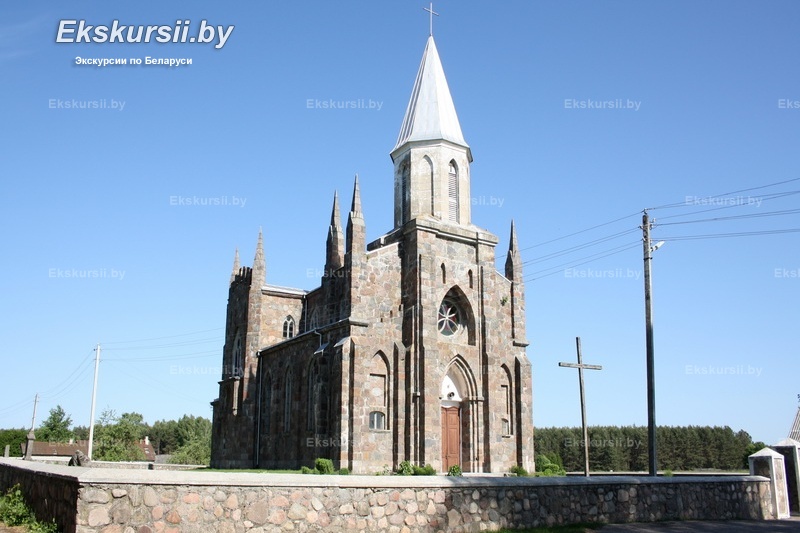
The architectural style of the Church of Mother of God of the Rosary in Peski is neo-Gothic, a style often found in Western Belarus. The church plan is a classical basilica with three naves, the side naves being noticeably lower than the central one. The church's facade is crowned by a bell tower with an octagonal tent. A transept with a crenellated completion is inscribed into the core of the building, and a pediment rises above the rear. The corners of the transept are decorated with pinnacles (decorative turrets).
The church is constructed of fieldstone and adorned with stained-glass windows that fill the entire space of the pointed-vaulted windows. The top tier of the white brick bell tower stands out against this massive stone mass. The use of fieldstone in the decoration gives the church a Nordic appearance, resembling a miniature knight's castle.